
The Community Land Trust Network (CLTN) is proud to launch a new Impact Report alongside a new ambitious Strategy for 2026-2030. Together, these documents mark a pivotal transition for the community land trust movement as it progresses on its journey to becoming a mainstream, catalytic force in England and Wales land and housing systems.
Our 2021-26 Impact
Our 2026-30 strategy
Proof of concept: A growing movement
Data from the last three years demonstrates that CLTs are no longer an experimental model. They are a proven delivery vehicle for the development and safeguarding of community assets, especially genuinely affordable homes.
-
-
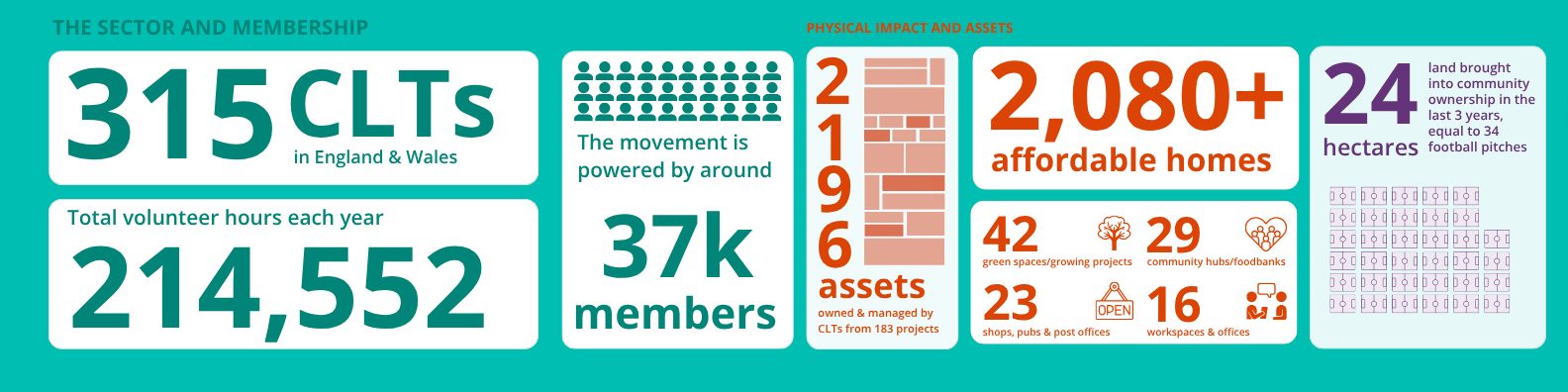
- The movement has grown to 315 legally incorporated CLTs across England and Wales, powered by 37,000 members.
- In the last three years alone, 26 CLTs have completed 333 affordable homes, providing secure housing for an estimated 783 residents.
- The movement brought 24 hectares of land, the equivalent of 34 football pitches, into permanent community ownership.
-
CLTN: Essential national infrastructure
Our Impact Report highlights that the success of these CLTs is directly linked to an active collective national network. As a network, we collectively campaign, learn and nurture the foundations that enable communities to overcome the system that is stacked against them.
- Data shows that 86% of CLTs that have folded since 2018 were either not members of the network or had minimal engagement with it.
- CLTN has supported 35 CLTs to incorporate, provided practical governance training to 82 people from 53 different CLTs, built an online member platform with hundreds of resources and hosted workshops based on member needs.
- In a landmark step, CLTN successfully secured a definition of Community-Led Development in the National Planning Policy Framework, which provides an essential legislative hook to rewire local planning policy. CLTN has also led the collective campaigning that has led to critical legal exemptions for CLT homes from legislation and policies that would have undermined or even banned community ownership.
- Before CLTN was established, the sector completed an average of 4 homes per year. Today, because of the developing ecosystem, the average is now 111 homes per year, and every one of those projects depended on one or more of the above collective achievements as well as the individual brilliance of each CLT.
Working as a CLT can often seem quite lonely when you are dealing with bigger, sometimes intimidating, organisations. Being part of a nationwide supportive and approachable peer network has been really helpful and provided many inspiring examples of what similar groups have achieved. The CLT Network’s campaigns work with the government to remove barriers to support CLTs is one of the things our CLT most appreciate.”
CLTs are a core element of our development strategy and we’ve seen first-hand the vital difference they can make. This is all about empowering people and thinking in terms of communities, not simply homes and infrastructure.
A thriving community-led development sector relies on strong collaboration across the sector. Partnering with the CLT Network lets us combine our legal expertise with their national reach. Wrigleys brings legal frameworks and governance expertise that help CLTs succeed. Together, we’re building the infrastructure and conditions for community-led development to flourish across England and Wales.
Being part of the CLT Network’s collective effort to get the Community Housing Fund enabled us to get planning for 20 affordable rented
homes in Hebden Bridge. We can also tap into the collective knowledge of the CLT Network and its membership whilst being available to share our knowledge and experience.“
Our vision: Scaling to 2050
Our new strategy sets a bold path for the coming decades. This is more than movement building. Our strategy is about transforming the entire system so that community ownership becomes commonplace rather than an exception.
- We aim to help scale the movement from around 2,100 assets today to 75,000 assets by 2050.
- Ultimately, with a fully rewired system, we believe the community-led development sector can account for 5% of all UK housing and property development.

Three pillars for lasting change
To reach this transformational scale, our 2026-2030 strategy focuses on three strategic pillars:
- Organising: Ensuring every community has the knowledge, relationships and capacity to run an effective, democratic CLT.
- Building infrastructure: Developing replicable products that can be taken off the shelf based on the conditions and needs of a local community. A live example of our innovation is our in-development £10 million financing vehicle designed to build 1,000 CLT social homes in partnership with housing associations.
- Rewiring the system: Wiring community-led development into the heart of national, regional and local policy, including the next generation of New Towns.
A call to action: Join the ecosystem
The wider community asset sector is deeply fragmented. For CLTs to become a truly catalytic force, we must value and develop the entire ecosystem.
We are inviting funders, policymakers and industry partners to help us rewire the system. This requires stabilising core funding for the national network and regional enablers to ensure the foundations of the movement are robust.
Together, we can make community ownership commonplace.
Please get in touch with Tom, CLTN CEO, if you would like to work in partnership with the CLT movement.